
Reproductive & Early-Life Nutrition Support
Survival & Resilience Support
Antioxidant Nutritional Support
A Collaboration for Better Broodstock Nutrition
The evaluation was conducted in collaboration with Vincent Teoh, an experienced commercial bullfrog farming practitioner in Perak, Malaysia, together with ExcelVite Sdn. Bhd. Approximately 30 breeding pairs were included in the initial evaluation, with six dietary treatments (0–5 g EVMarineGro™ (P)/kg feed). Reproductive parameters, including egg characteristics, hatch rate and 7-day tadpole survival, were monitored.

Vincent Teoh
Commercial Bullfrog Farming Practitioner Perak, Malaysia.
“Broodstock management is one of the most important but challenging aspects of commercial bullfrog production. Our interest was to determine specific nutritional enrichment of the broodstock and its contribution to better reproductive outcomes and stronger early-stage survival under actual farm conditions. “

Dr. Liew Sien Yei
ExcelVite Sdn. Bhd. Application & Technical Development.
“The value of this project goes beyond testing an ingredient. Vincent’s practical knowledge of bullfrog reproduction allowed us to evaluate the nutritional concept within the realities of commercial farming. The encouraging first-spawning results give us a foundation to continue refining the application together and, ultimately, to explore how this approach could be translated into formulated broodstock feed.”
Mean 7-Day Tadpole Survival by EVMarineGro™ (P) Inclusion
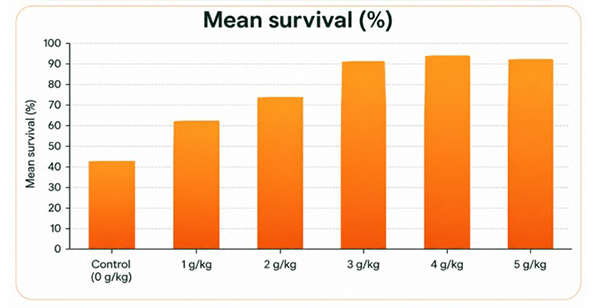
Positive Numerical Trend in Hatch Rate
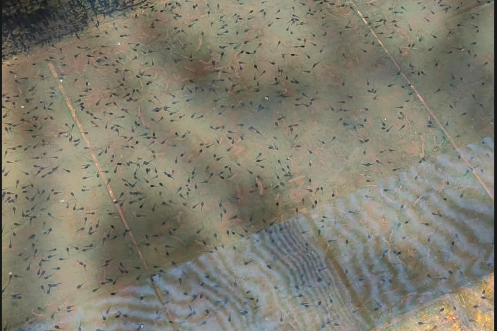
Tadpole survival observations
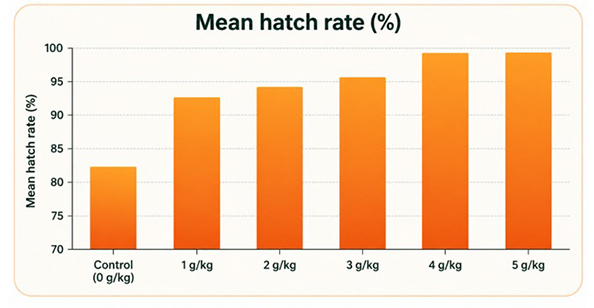
Encouraging Numerical Trend in Hatch Rate
Hatchability showed another encouraging pattern. Mean hatch rate increased numerically from 82.56% in the control to 99.22% and 99.33% in the 4 and 5 g/kg groups, respectively.
Preliminary analysis indicated that this response approached, but did not reach, the conventional threshold for statistical significance. It should therefore be interpreted as a positive numerical trend requiring further confirmation, rather than a confirmed treatment effect.
Overall egg diameter remained relatively consistent among treatment groups. Yolk diameter showed an exploratory numerical increase at higher supplementation levels, although further evaluation is required to establish whether this observation is biologically meaningful.